Overview
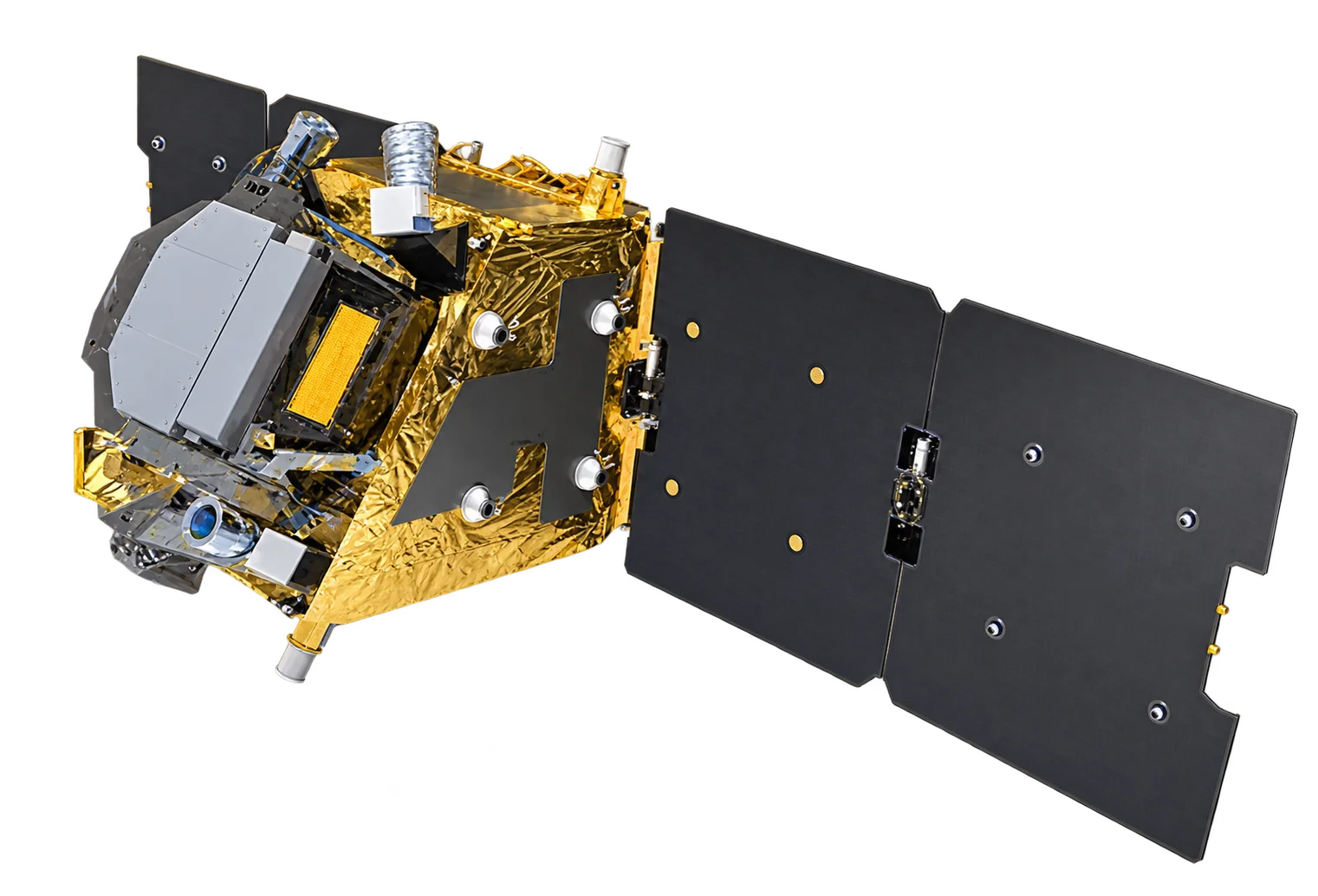
FLEX (FLuorescence EXplorer) is the eighth mission in ESA's Earth Explorer programme. It launched on 15 September 2026 on the first dual-payload Vega C flight, sharing the rocket with Sentinel-3C. FLEX measures solar-induced chlorophyll fluorescence, a faint red and far-red glow emitted by plants as they absorb sunlight for photosynthesis. Fluorescence responds to stress before leaves visibly change colour, making it an early signal of drought, heat and disease.
FLORIS Instrument
- Imaging spectrometer - Two spectrometers covering 500 to 780 nm
- Very fine spectral sampling - Sub-nanometre sampling in the oxygen absorption bands where the fluorescence signal can be separated from reflected sunlight
- 300 m resolution - Field-scale observation across a 150 km swath
- Tandem with Sentinel-3 - Flies in formation so that Sentinel-3's OLCI and SLSTR instruments supply surface temperature, cloud and atmospheric data for each FLEX observation
Measurements
- Chlorophyll fluorescence - Full fluorescence spectrum at canopy level
- Photosynthetic activity - Estimates of how actively vegetation is converting light to carbon
- Vegetation stress - Early detection of water, heat and nutrient stress
Data Access
FLEX data will be free and open through ESA once the satellite completes commissioning.
Applications
- Agriculture - Early warning of crop stress and yield risk
- Food security - Regional monitoring of crop health
- Forestry and ecosystems - Tracking drought response and vegetation productivity
- Carbon cycle science - Better estimates of how much carbon vegetation absorbs
Image: ESA, CC BY-SA 3.0 IGO.