Overview
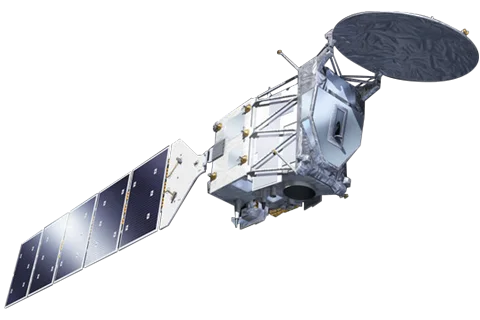
EarthCARE (Earth Cloud Aerosol and Radiation Explorer) is the largest of ESA's Earth Explorer missions and was built in partnership with the Japan Aerospace Exploration Agency (JAXA). It flies four instruments together to observe clouds, aerosols and radiation at the same time and place, helping to resolve one of the largest uncertainties in climate prediction.
Instruments
- ATLID - Atmospheric lidar at 355 nm that profiles thin cloud and aerosol layers
- CPR - JAXA's 94 GHz Doppler Cloud Profiling Radar that measures cloud structure and vertical motion
- MSI - Seven-band Multi-Spectral Imager at 500 m resolution that places the profiles in context across a 150 km swath
- BBR - Broadband Radiometer measuring reflected sunlight and emitted heat at the top of the atmosphere
Low Orbit
At about 393 km, EarthCARE flies lower than most Earth observation satellites. This improves the signal strength of its lidar and radar but means it needs regular orbit-raising manoeuvres to counter atmospheric drag.
Data Access
EarthCARE data is free and open through ESA and JAXA.
Applications
- Climate modelling - Improving how clouds and aerosols are represented in climate models
- Weather forecasting - Assimilating cloud and aerosol profiles into forecast models
- Air quality - Tracking smoke, dust and pollution layers in 3D
- Radiation budget - Measuring the balance of energy entering and leaving the Earth